
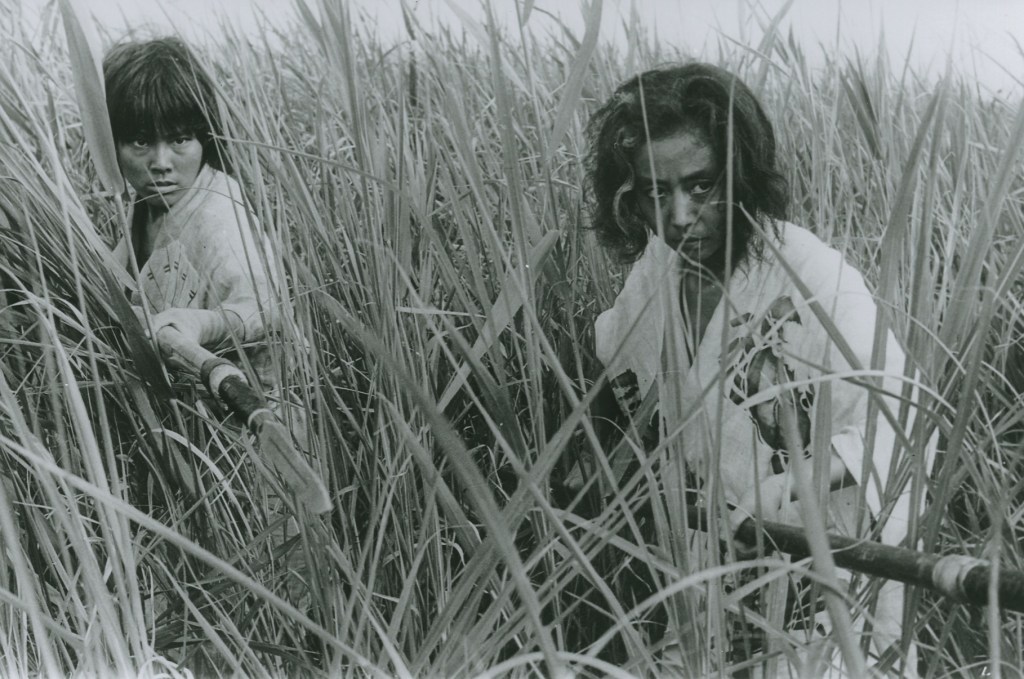
I laid back today and put on a movie that never ceases to be a unique cinematic experience. ‘Onibaba’ (1964) directed by Kaneto Shindō is the story of two women known only as Younger woman and Older Woman, who survive out in the countryside as a war rages around them by killing and looting wandering soldiers and Samurai who have the misfortune to be consumed in their tall fields of Susuki grass. Once the murder is done the women drop their victims into a large hole hidden by the Susuki grass and barter what they have stolen to a local merchant for sacks of rice and flour. This is how the women live until a young army deserter named Hachi enters their lives and tells them that the young woman’s husband Kishi who was also the older woman’s son is dead…What follows can only be described as a nightmare.
The locations are minimal consisting of the Women’s home near a river bank and the fields of grass that sway in the winds but with only these two elements of wind and water, Kaneto Shindō creates one of the most hypnotic and dream like locations that I have ever seen in cinema. Onibaba, although a dark and disturbing horror movie about death, longing, loneliness and everything in between, is a mesmerising and beautiful nightmare that is one of the greatest movies of the early 1960’s.
This is also a movie that director of The Exorcist William Friedkin called one of the most terrifying movies ever made. Without spoiling the movie for anyone who is interested in seeing this masterpiece, I say not to inspect the film to much for meaning and themes as the nightmarish narrative does fall apart on close inspection, although Kaneto Shindō said that parts of the film are a symbolic representation of the disfigurement that befell victims of the Atom bombs dropped on Hiroshima and Nagasaki and reflects the trauma of post-war Japanese society.
The best way to watch this movie is to let it wash over you like a dream and I promise you if you are looking for unique, mesmerising and original filmmaking that asks you to dream along with the filmmakers then this classic just might be for you.
Are you a fan of Onibaba and the work of Kaneto? Let me know in the comments below and if you do decide to watch let me know what you think of this dramatic masterwork of cinema.
 BONEYARD CINEMA
Leave a comment